

The Boy Who Added a Year and the Man Who Took Fifteen Off
In September 1915 a civil servant from Fremantle walked into the recruiting office in Perth and told the army he was 18 years and 5 months old. He was 17. Twenty months later, in Sydney, his uncle told the army he was 44. He was 58.
Neither lie was unusual. The Australian Imperial Force took volunteers between 18 and 45, and both ends of that range leaked. Boys added years; old men subtracted them. What makes the Bushbys worth telling is that the two liars were uncle and nephew, that the army’s paperwork about each of them survives in full, and that for a few weeks in the autumn of 1917 they were soldiers on the same stretch of English chalk.
The nephew
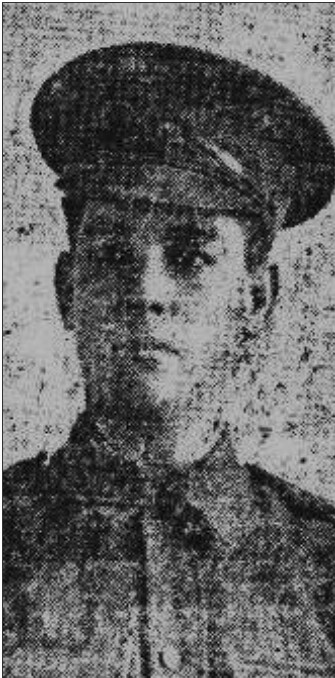
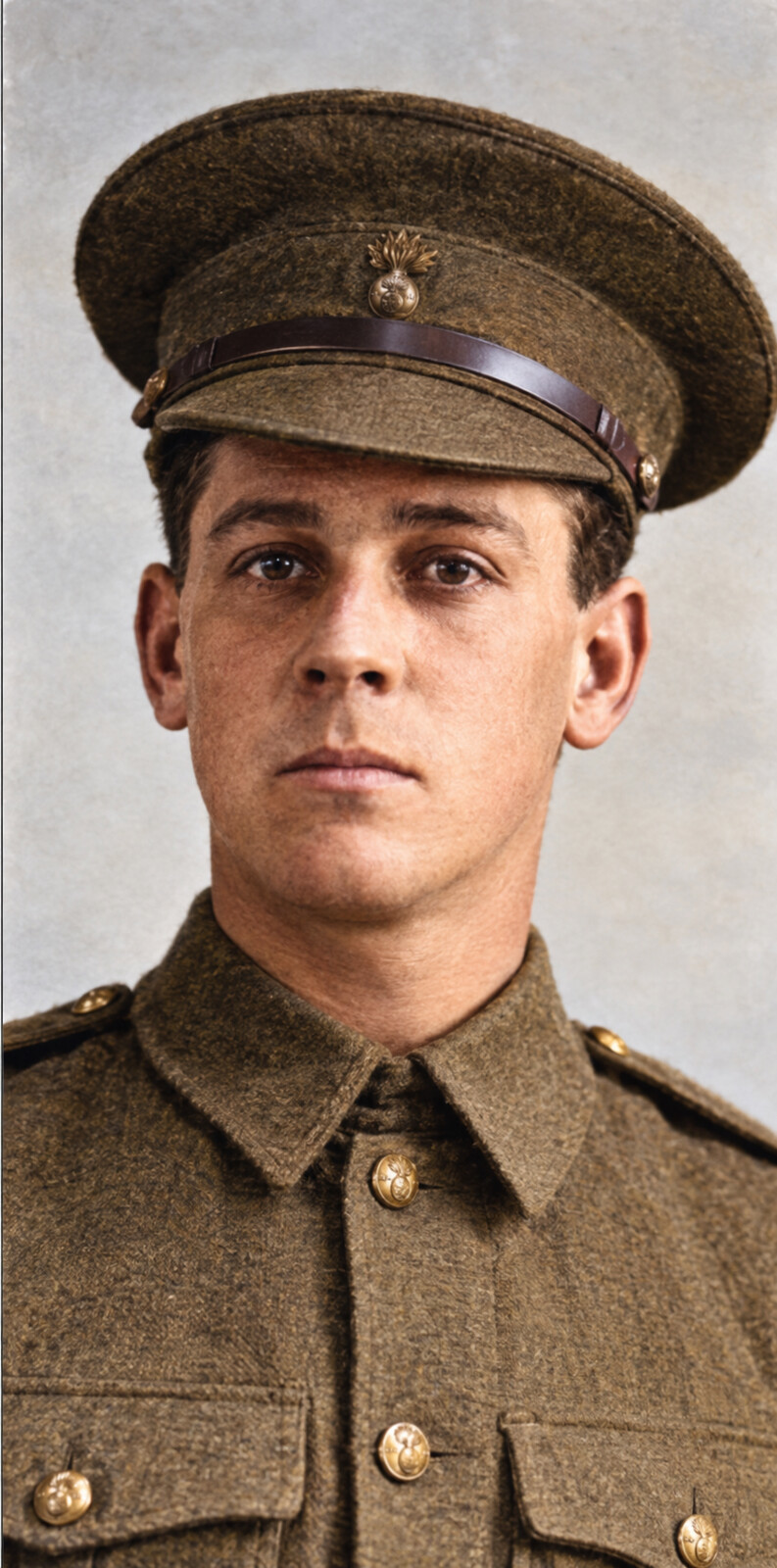
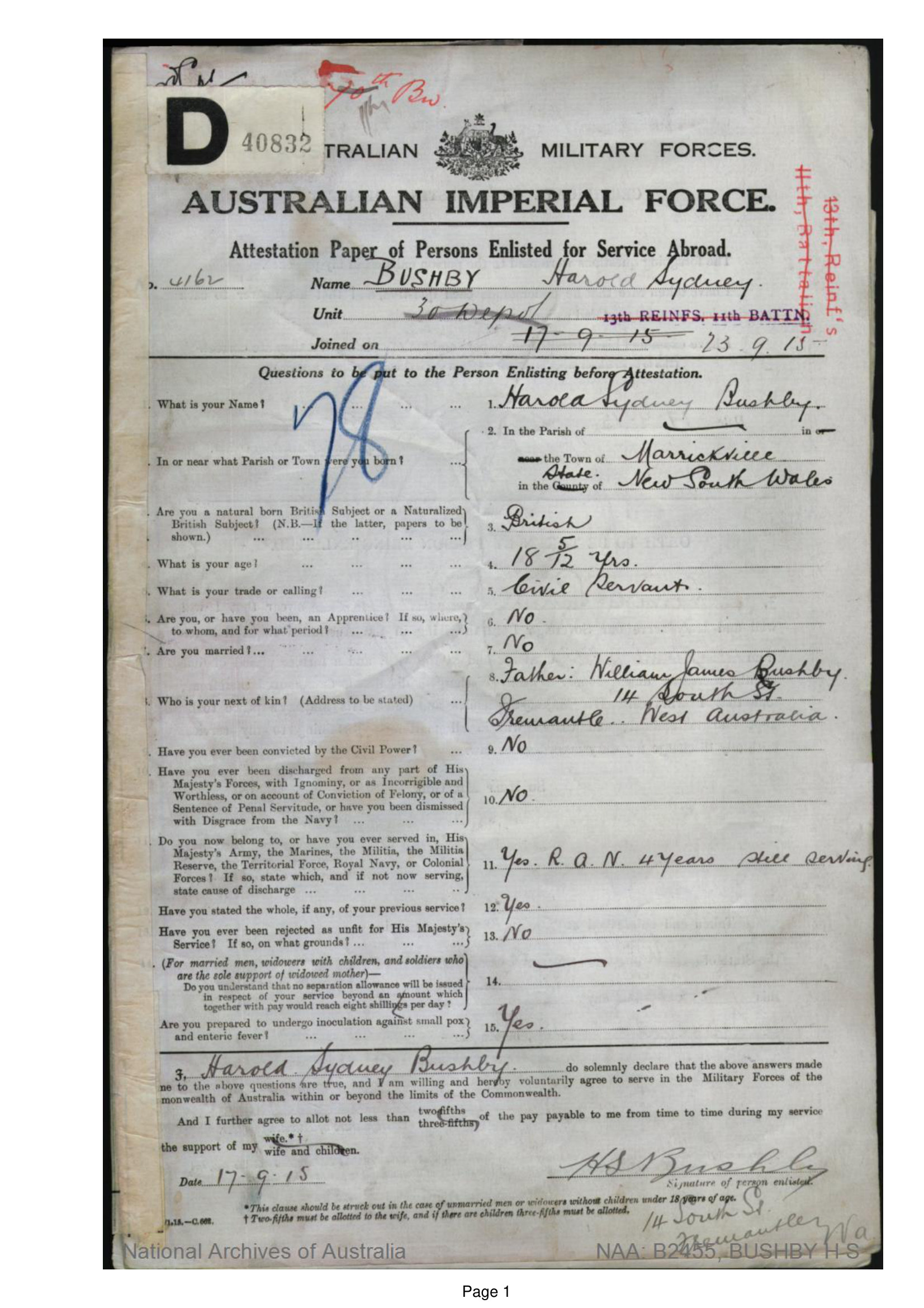
Harold Sydney Bushby was born at Marrickville, Sydney, on 18 April 1898, the son of William James Bushby and Sarah Jane Buhl. The family moved west, and by the war they lived at 14 South Street, Fremantle. Harold was registered as a naval cadet at Fremantle in 1912, and when he enlisted he gave his previous service as “R.A.N. 4 years still serving”. His parents both signed the consent form for “persons under 21 years of age”. The age he wrote down, 18 years 5 months, matches his birthday to the month. Only the year is wrong.
He sailed from Fremantle on the transport Borda on 17 January 1916. In Egypt he caught influenza, and Base Records in Melbourne wrote to his father in the reassuring formula of the day: “In the absence of further reports, Egypt advises it is to be assumed that satisfactory progress is being maintained.” In France he caught mumps. Then he joined the 11th Battalion in the line, in July 1916, in time for Pozières.
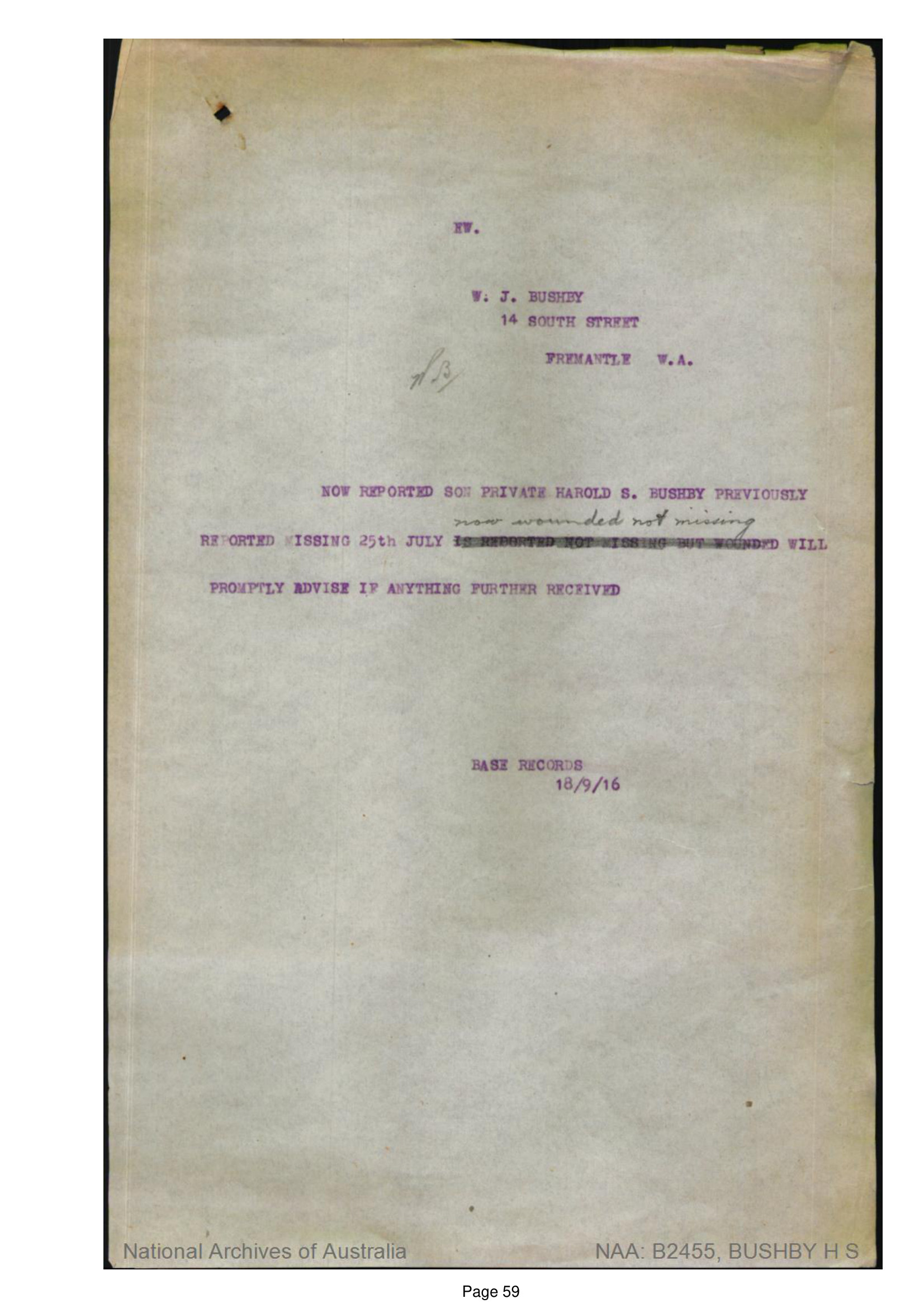
On 25 July 1916 he was reported missing. The battalion called him wounded; the field ambulance, the casualty clearing station and the general hospital at Etaples all called it shell shock. In Melbourne two cables arrived, one saying missing and one saying wounded, and a clerk noted that the records were “queried re conflicting reports”. His father was told on 12 August that Harold was missing. Not until 18 September, nearly eight weeks after the event, did a telegram reach 14 South Street. A clerk had begun to type “IS REPORTED NOT MISSING BUT WOUNDED”, struck it out, and written above it in pen: “now wounded not missing”.
Harold went back to the line in October. In January 1917 a fever took him to hospital, then across the Channel on the hospital ship Dunluce Castle to Brighton. By April he had been posted to the 70th Battalion in Dorset, and in August he passed the Southern Command test as a first-class signaller. On 19 September he was sent back to the 11th Battalion by way of the 3rd Training Battalion at Durrington, on Salisbury Plain. He left for France from there on 18 October 1917.
The uncle
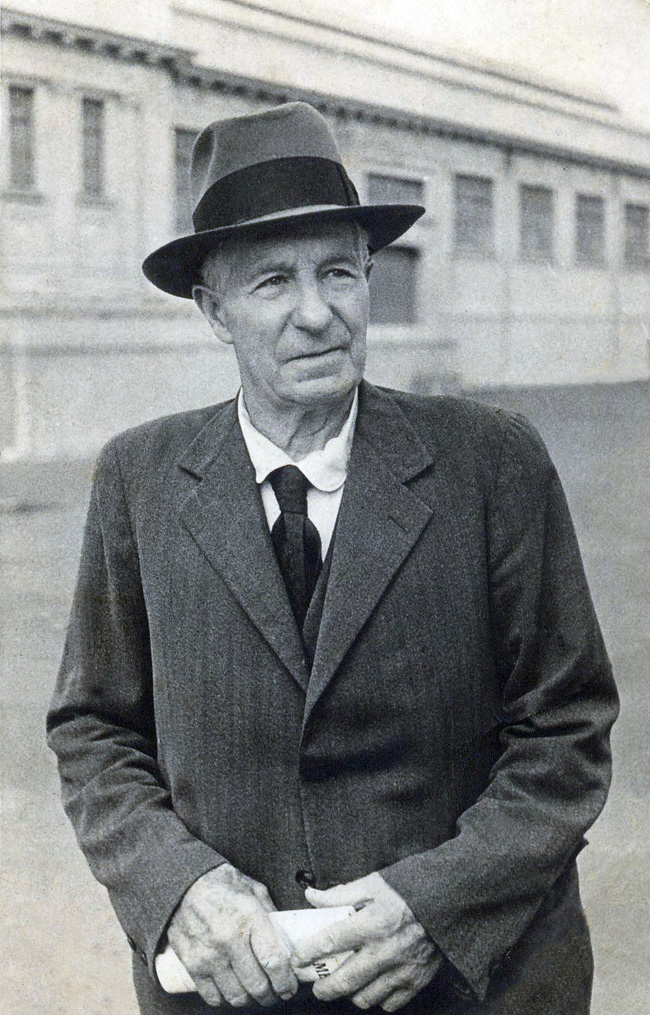
Robert Bushby was born at Killearn, Stirlingshire, on 30 June 1858, the son of James Bushby and Martha Aitken. Harold’s father William James was his younger brother. By the 1890s he was in Sydney, working on the railways as a bridge inspector and overseer of railway works. He was teetotal, did not smoke, and in 1917 was living with his second wife, Amy Elizabeth, at 36 Toxteth Road, Glebe.
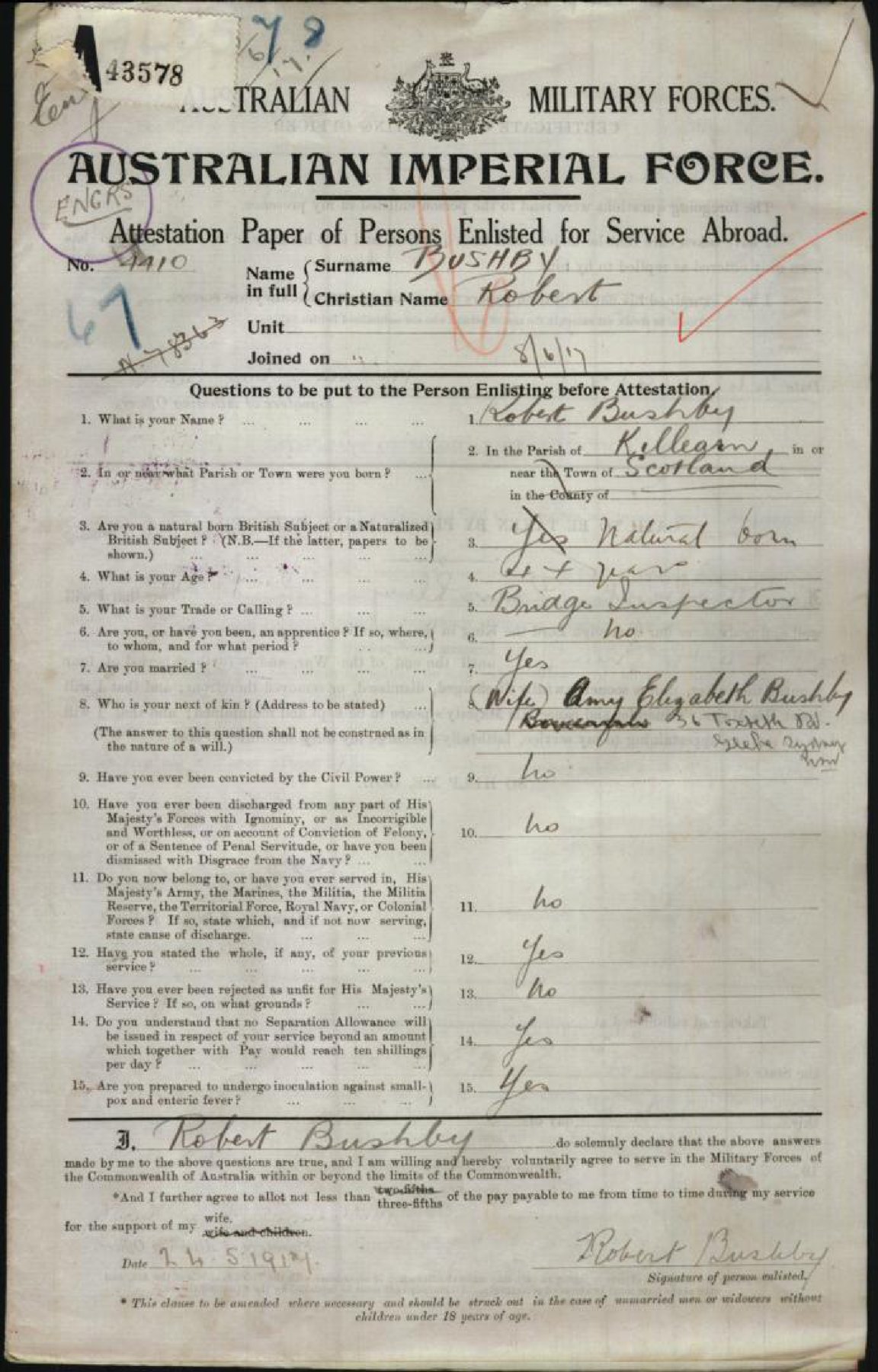
On 24 May 1917 he enlisted in Sydney. To the question “What is your age?” he answered “44 years”. He was 58. The doctor passed him fit, he was taken into the Engineer Reinforcements at the Show Ground Camp, and within a fortnight he was a private in the 12th Reinforcements of the 1st Pioneer Battalion. He sailed from Melbourne on the transport Suevic on 21 June 1917 and landed at Liverpool on 26 August, two months past his 59th birthday.
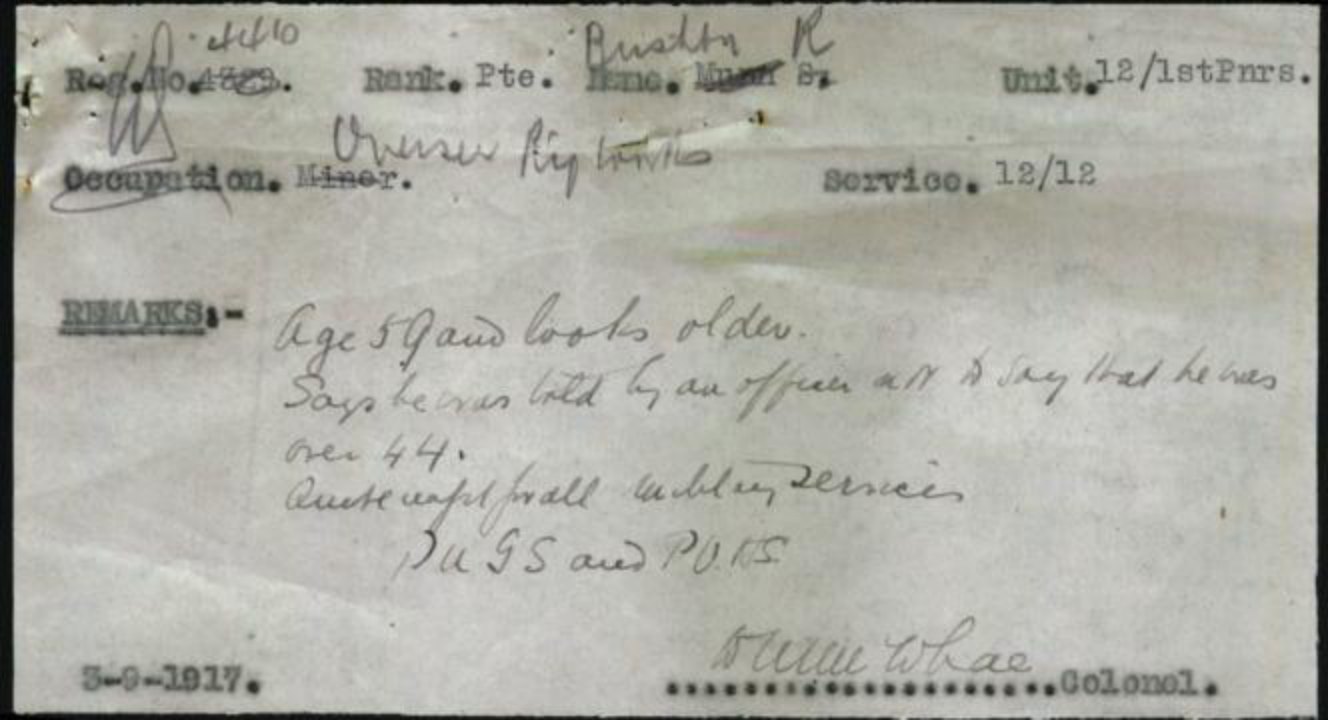
The army looked at him properly in England. The Pioneer Training Battalion was at Fovant, in Wiltshire. A medical board there wrote down what Robert told them: no disability, “never remembers being ill, never has colds and is confident he could carry out all work. A little shortwinded on heavy exertion. Claims to be skilled at mining, all railway works, bridge building, etc. Has always been teetotal and does not smoke.” Then a colonel wrote the verdict on a slip dated 3 September 1917: “Age 59 and looks older.” Robert told the colonel an officer had told him what age to give. The diagnosis on his papers was a single word: senility.
So in the autumn of 1917 the uncle was at Fovant waiting to be sent home, and the nephew was at Durrington waiting to go back to France. The two camps are about fifteen miles apart on the same plain. Nothing in either file says they met, or even that either knew the other was there. Robert sailed for Australia on the hospital ship Anchises on 1 November 1917, two weeks after Harold crossed back to France.
January and February 1918
Harold rejoined his battalion on 23 October 1917. In January 1918 he went sick again, with a fever of unknown origin, to the 1st Australian Divisional Rest Station. He was discharged to duty on 19 January. One week later, on 26 January 1918, he was killed in action. He was 19.
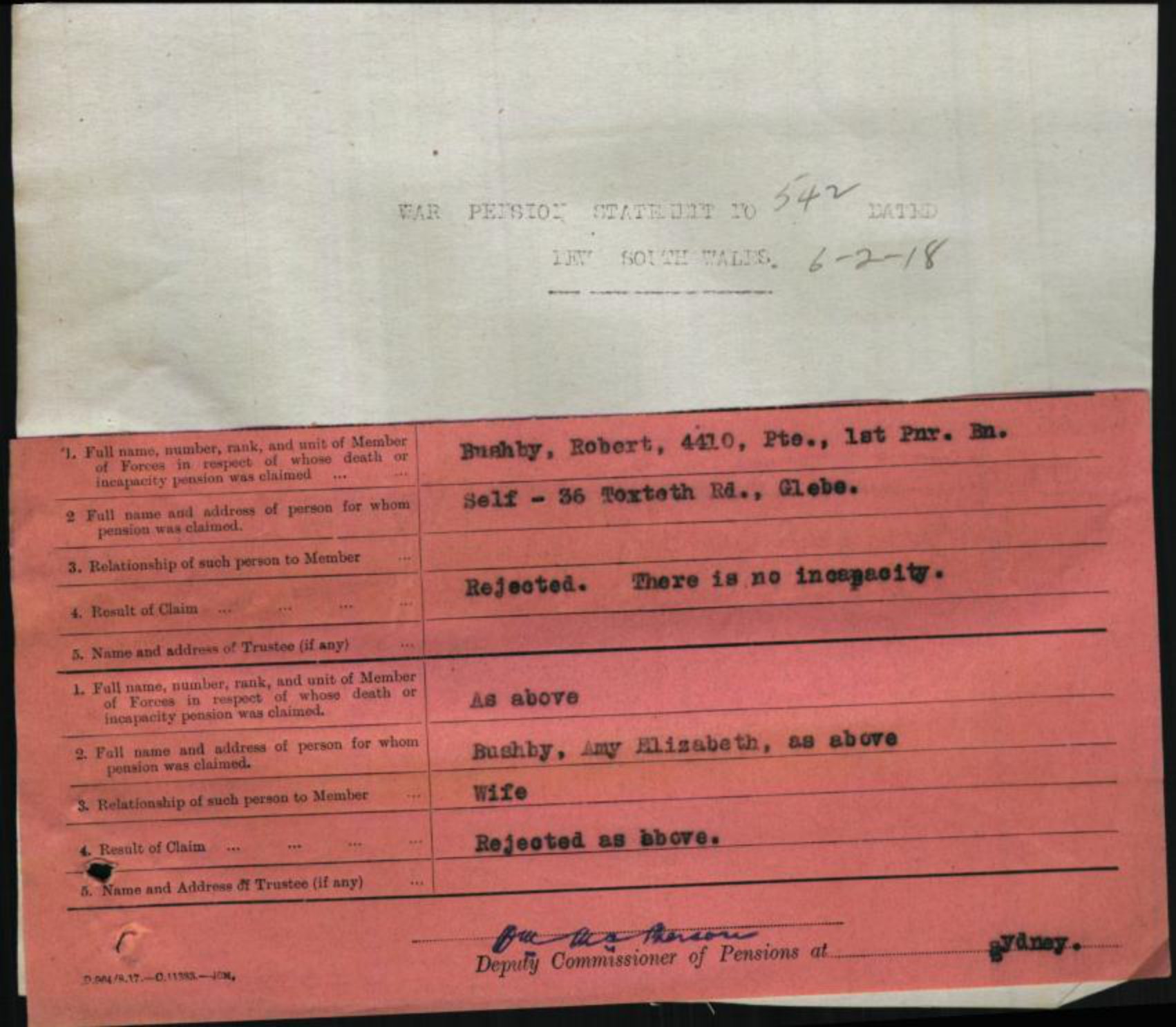
Robert’s ship reached Australia that January. On 6 February the Pensions Commissioner in Sydney rejected his claim for an incapacity pension in four words: “There is no incapacity.” On 11 February he was discharged from the AIF as medically unfit. On 14 February, in Perth, the army told Harold’s family that he had been killed.
On 25 February 1918, eleven days later, Robert Bushby enlisted again.
This time he told the truth: 59 years and 8 months, born 30 June 1858, clerk of works. He listed his previous service honestly too: “1st Pioneers Battn, 293 days, med. unfit”. The army had a use for an honest 59-year-old. He was taken into the Australian Naval and Military Expeditionary Force, the garrison of the former German colonies in New Guinea, and his papers are headed “Tropical Forces”.
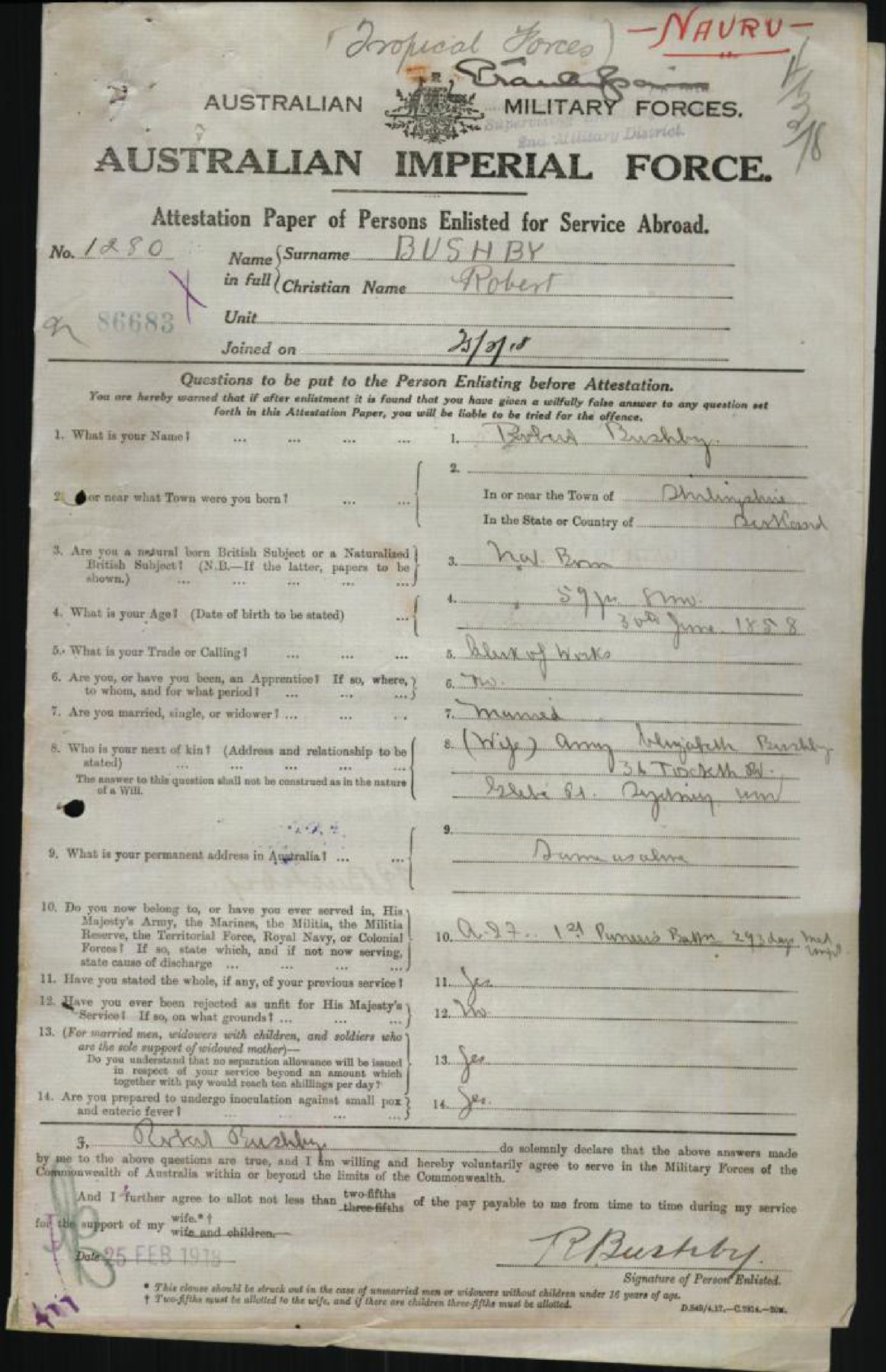
Did Robert know when he re-enlisted that his nephew was dead? The files don’t say. The family in Fremantle had been told only on the 14th, on the other side of the continent. The dates fit a man who heard and went back, but that is an inference, and it is the only place in this story where the paperwork falls silent.
Rabaul
Robert sailed from Sydney on the Morinda on 20 March 1918 and was taken on strength at Rabaul on 8 April. On 3 May he was appointed wharfinger, Class 4, at seven shillings a day, and seconded to the department of the King’s Harbour Master. A railway bridge inspector had become the man who ran the wharf. In January 1919 his pay went up to nine shillings a day.
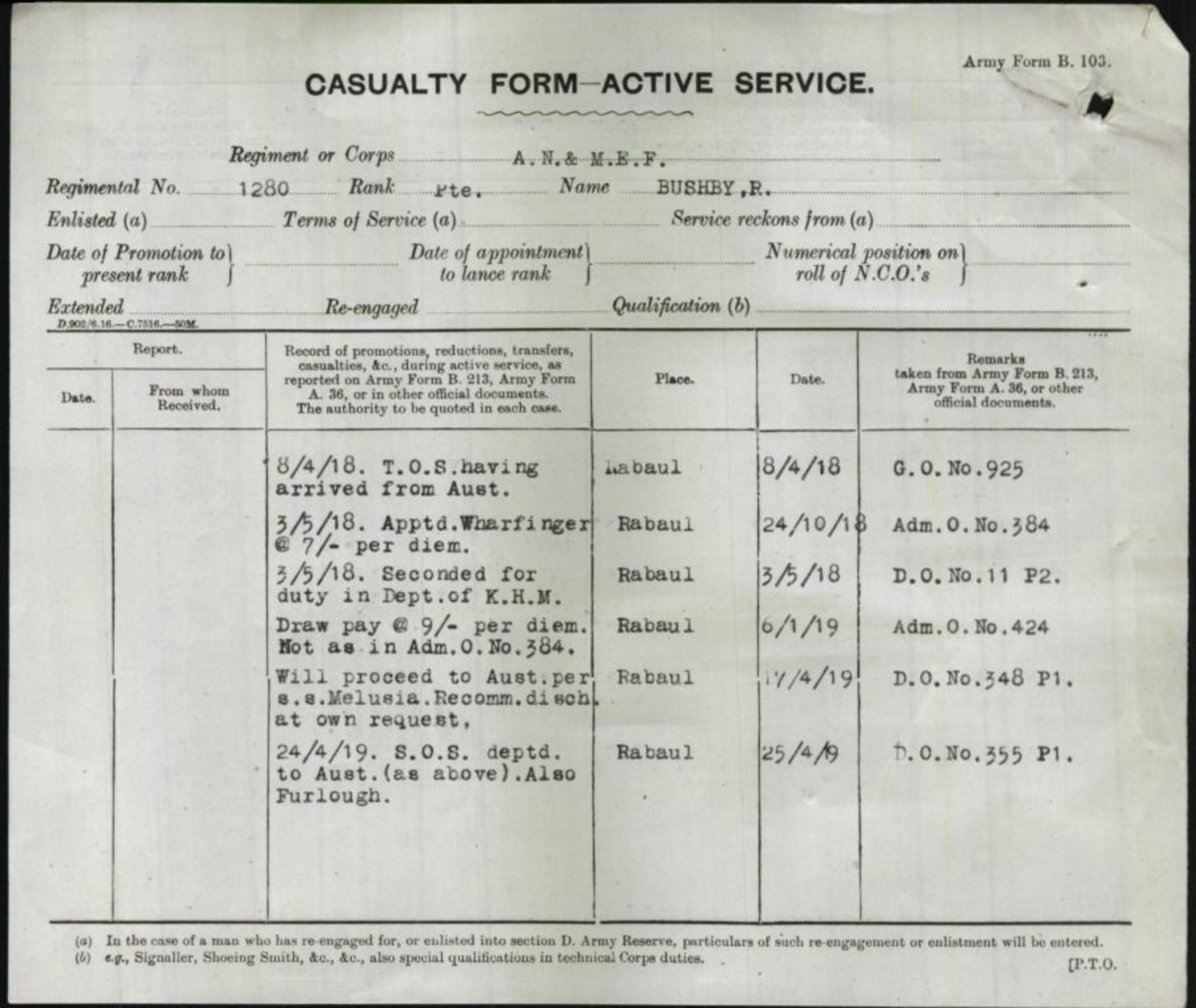
The war ended while he was there. In April 1919 he asked to go home, and on 24 April he left Rabaul on the Melusia, his discharge “recommended at own request”. He was nearly 61.
The paperwork of death
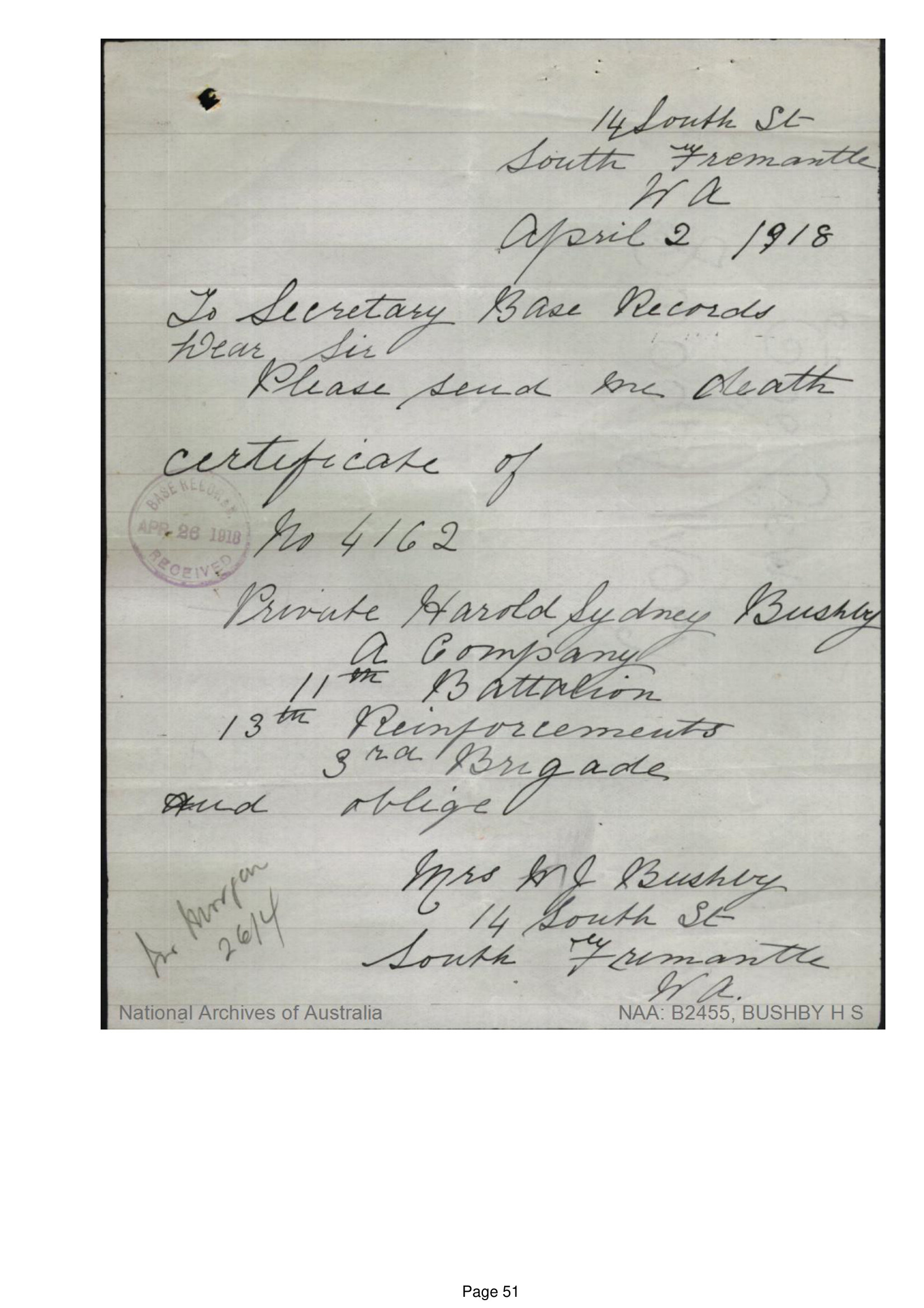
Back in Fremantle, Sarah Jane Bushby was learning how the army handled a dead son. On 2 April 1918 she wrote to Base Records in Melbourne: “Please send the Death certificate of No 4162 Private Harold Sydney Bushby … and oblige.” The letter was stamped received on 26 April, and the certificate was issued on the 30th.
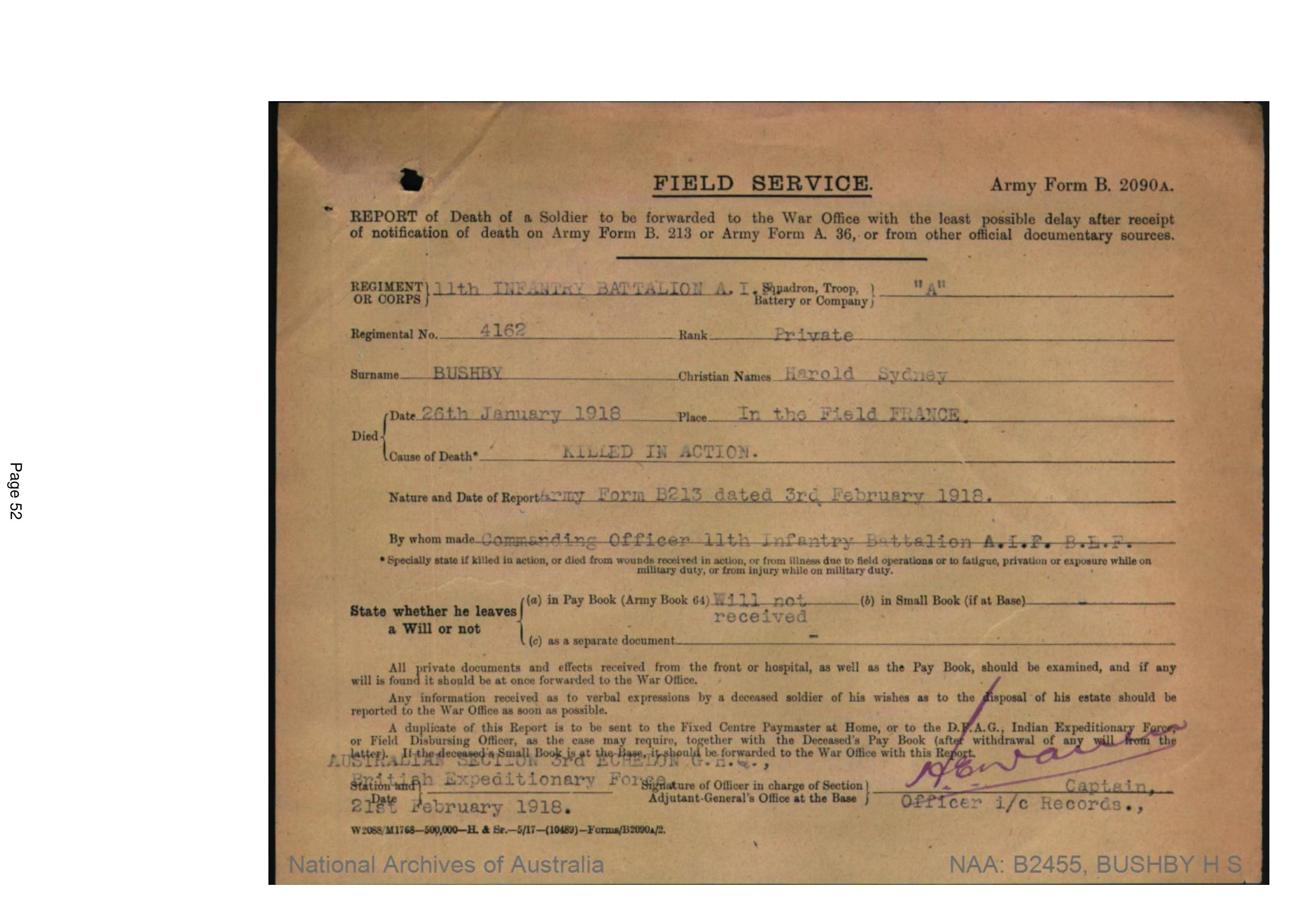
The army’s Report of Death said “Will not received”. Two wills survive later in the same file, a formal will made at the YMCA hut at Blackboy Hill camp before he sailed and a will in his paybook, and both leave everything to his mother.
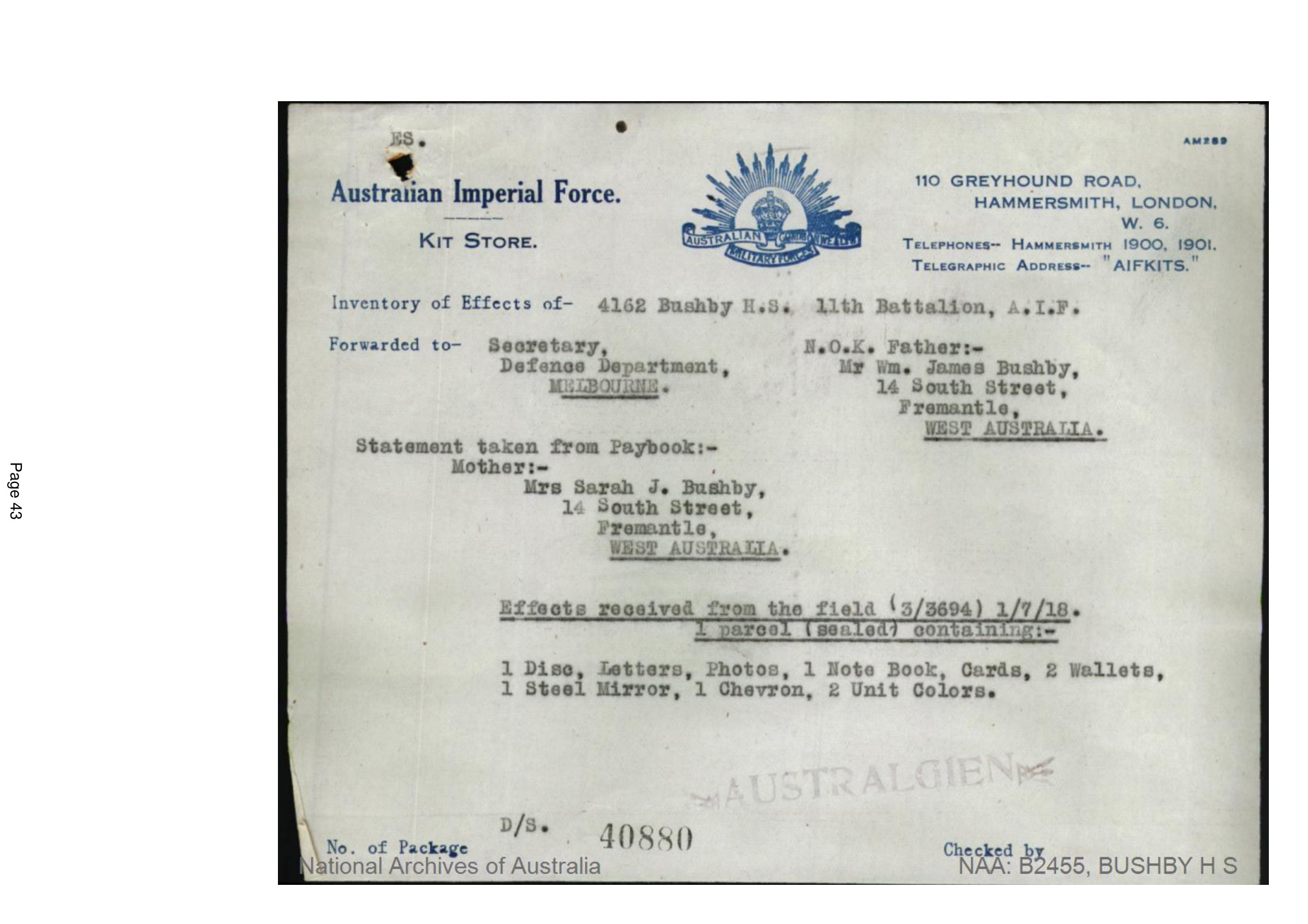
His effects (a disc, letters, photographs, a notebook, two wallets, a steel mirror, a chevron and two unit colour patches) reached the Kit Store in London in July 1918. They were posted to Sarah Jane in March 1919, with a printed warning to check that the seals were intact.
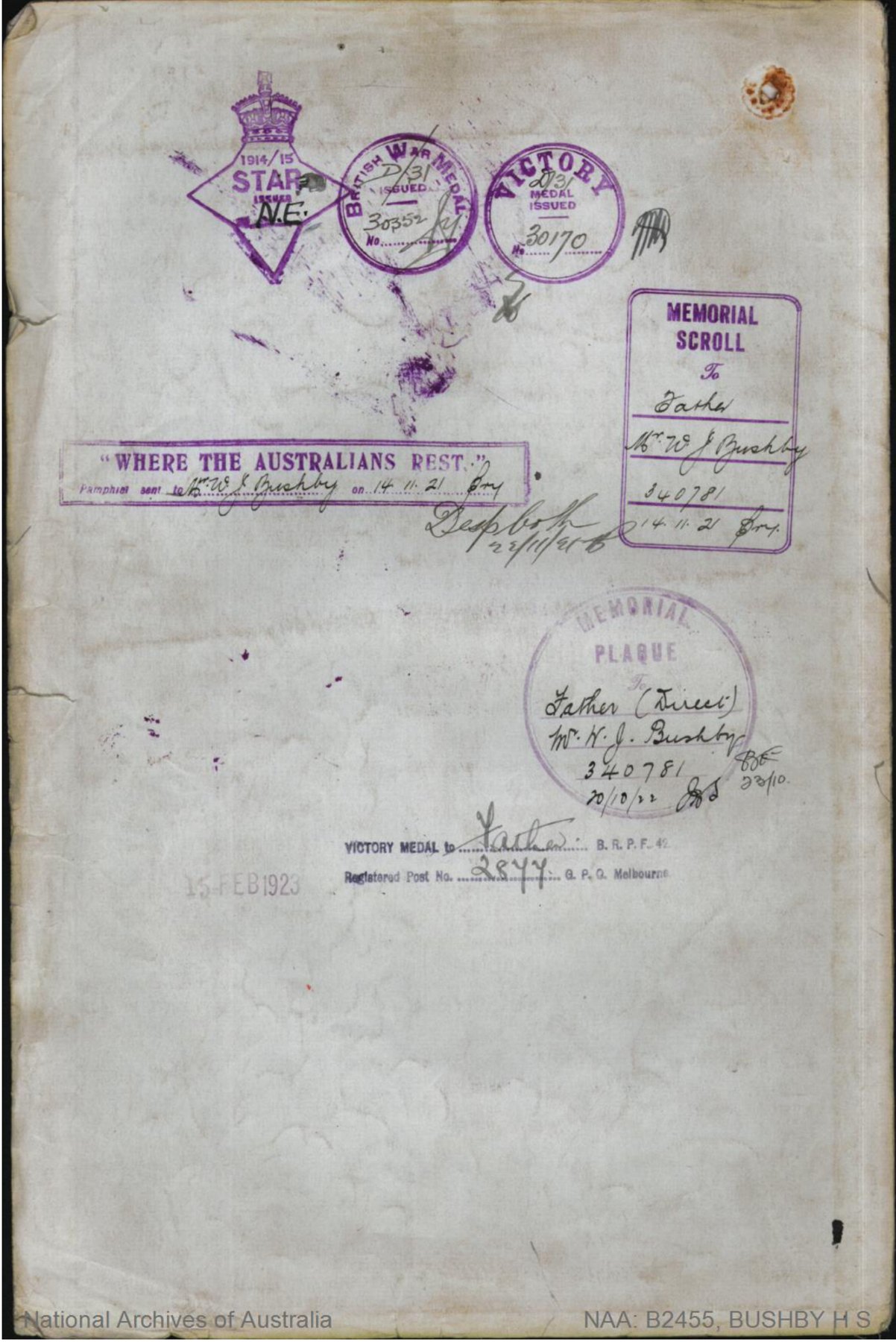
In May 1920 his father was told where he was buried: Messines Ridge British Cemetery, Plot I, Row A, Grave 41, among men brought in from scattered field graves. A photograph of the grave followed. The British War Medal came in 1921, the memorial scroll later that year, the bronze plaque in 1922, and the Victory Medal in February 1923, five years after his death. Each was recorded with a purple stamp on the back cover of his file.
The Imperial War Graves Commission’s register gives his age as 19 and calls him a native of Marrickville. It was the one official record that got his age right.
Afterwards
Robert Bushby lived another quarter of a century. He died at a private hospital in Marrickville on 17 August 1945, aged 87, a few miles from where his nephew had been born.
Sources
- National Archives of Australia, B2455, BUSHBY H S (item 3175365): Harold Sydney Bushby’s service file, 66 pages. On the family tree as a scanned PDF and a full typed transcription.
- National Archives of Australia, B2455, BUSHBY R (item 3175372): Robert Bushby’s service file, 60 pages, covering both enlistments. On the family tree as a scanned PDF.
- New South Wales birth registration of Harold Sydney Bushby, 18 April 1898; Scottish birth registration of Robert Bushby, Killearn, 30 June 1858.
- Imperial War Graves Commission, register of Messines Ridge British Cemetery (Belgium 168).
- City of Fremantle Local History Centre, “Fremantle Soldiers, Sailors and Nurses of the Great War”: Harold Sydney Bushby.
Everything in this article about Harold and Robert comes from the records above, except where it says otherwise. The one guess, whether Robert knew of Harold’s death when he re-enlisted, is marked as a guess. The colour portrait of Harold is an AI impression, not a photograph. More about the family, with their records, is on their pages in the family tree. Corrections and additions are welcome through our contact form.